The School of Architecture, Computing, and Engineering envisions to be premier provider of engineering, architecture, and interior design education thereby committing itself to produce highly competitive and dynamic Christian engineering, architecture, and Information Technology experts locally and globally.
- develop students professionally with the knowledge, attitudes and skills to contribute substantially to the technological needs of the society;
- inculcate in the students the desire and determination to constantly enhance their expertise through quality research in engineering, architecture, interior design and information technology and interactive linkages with professional organizations and agencies;
- mold students to be involved in community and extension services in response to the social, economic and environment needs of society.
- Equip students with adequate knowledge, technical and human skills, and Christ-centered values to contribute substantially to the technological needs of the society.
- Inculcate in the students the desire and determination to constantly enhance their expertise through quality researches and interactive linkages with professional organizations and agencies.
- Mold students to be actively involved in outreach, community extension services, and service-learning programs in response to the social, economic, and environmental needs of society.
Center of Development in Information Technology
Top Performing School in Licensure Exams – Electrical Engineering, Civil Engineering, Geodetic Engineering, Master Electrician, and Electronics Technician (Awarded by the Professional Regulation Commission)
Level IV PAASCU Re-Accredited Program – Civil Engineering
Level III PAASCU Accredited Program – Electrical Engineering
Level II PAASCU Accredited Programs – Computer Science, Information Technology
Level I PAASCU Accredited Program – Computer Engineering


Bachelor of Science in Civil Engineering
PEO 1: Demonstrate Christian values, uphold ethical standards, and embody a mission-driven commitment in both professional practice and personal life.
PEO 2: Engage in continuous professional development, advanced studies, research, and active involvement in professional organizations to adapt to technological advances and contribute to the evolving needs of the local and global civil engineering profession.
PEO 3: Establish successful careers in civil engineering by applying technical expertise, smart technologies, and innovative practices, while demonstrating a research-oriented and data-driven mindset for problem solving
PEO 4: Display effective leadership, communication and teamwork skills, enabling them to collaborate with multidisciplinary and multicultural teams.
PEO 5: Contribute to society through innovative solutions and community engagement, promoting sustainable development for resilient communities.
Bachelor of Science in Geodetic Engineering
PEO 1: Demonstrate Christian values, uphold ethical standards, and embody a mission-driven commitment in both professional practice and personal life.
PEO 2: Engage in continuous professional development, advanced studies, research, and active involvement in professional organizations to adapt to technological advances and contribute to the evolving needs of the local and global geodetic engineering profession.
PEO 3: Establish successful careers in geodetic engineering by applying technical expertise, smart technologies, and innovative practices, while demonstrating a research-oriented and data-driven mindset for problem solving
PEO 4: Display effective leadership, communication and teamwork skills, enabling them to collaborate with multidisciplinary and multicultural teams.
PEO 5: Contribute to society through innovative solutions and community engagement, promoting sustainable development for resilient communities.
Bachelor of Science in Electrical Engineering
PEO 1: Demonstrate Christian values, uphold ethical standards, and embody a mission-driven commitment in both professional practice and personal life.
PEO 2: Engage in continuous professional development, advanced studies, research, and active involvement in professional organizations to adapt to technological advances and contribute to the evolving needs of the local and global electrical engineering profession.
PEO 3: Establish successful careers in electrical engineering by applying technical expertise, smart technologies, and innovative practices, while demonstrating a research-oriented and data-driven mindset for problem solving
PEO 4: Display effective leadership, communication and teamwork skills, enabling them to collaborate with multidisciplinary and multicultural teams.
PEO 5: Contribute to society through innovative solutions and community engagement, promoting sustainable development for resilient communities.
Bachelor of Science in Electronics Engineering
PEO 1: Demonstrate Christian values, uphold ethical standards, and embody a mission-driven commitment in both professional practice and personal life.
PEO 2: Engage in continuous professional development, advanced studies, research, and active involvement in professional organizations to adapt to technological advances and contribute to the evolving needs of the local and global electronics engineering profession.
PEO 3: Establish successful careers in electronics engineering by applying technical expertise, smart technologies, and innovative practices, while demonstrating a research-oriented and data-driven mindset for problem solving
PEO 4: Display effective leadership, communication and teamwork skills, enabling them to collaborate with multidisciplinary and multicultural teams.
PEO 5: Contribute to society through innovative solutions and community engagement, promoting sustainable development for resilient communities.
Bachelor of Science in Computer Engineering
PEO 1: Demonstrate Christian values, uphold ethical standards, and embody a mission-driven commitment in both professional practice and personal life.
PEO 2: Engage in continuous professional development, advanced studies, research, and active involvement in professional organizations to adapt to technological advances and contribute to the evolving needs of the local and global computer engineering profession.
PEO 3: Establish successful careers in computer engineering by applying technical expertise, smart technologies, and innovative practices, while demonstrating a research-oriented and data-driven mindset for problem solving
PEO 4: Display effective leadership, communication and teamwork skills, enabling them to collaborate with multidisciplinary and multicultural teams.
PEO 5: Contribute to society through innovative solutions and community engagement, promoting sustainable development for resilient communities.
Bachelor of Science in Architecture
PEO 1: Live-out CICM values both professionally and personally as manifested in their practice as architects.
PEO 2: Take on leadership roles in the workplace and the community.
PEO 3: Are highly valued architects in the industry, academe, and/or government.
PEO 4: Pursue professional growth through advanced studies, attendance to trainings and seminars, and active membership in architecture professional organizations.
PEO 5: Demonstrate engagement in the improvement of the community and the environment.
Bachelor of Science in Computer Engineering
PLO 1: Apply knowledge of mathematics and sciences to solve complex engineering problems.
PLO 2: Design and conduct appropriate experimentation, analyze and interpret data.
PLO 3: Design a system, component, or process to meet desired needs within realistic constraints such as economic, environmental, social, political, ethical, health and safety, manufacturability, and sustainability in accordance with standards.
PLO 4: Function effectively on multi-disciplinary and multi-cultural teams that establish goals, plan tasks, and meet deadlines.
PLO 5: Identify, formulate, and solve complex problems in computer engineering.
PLO 6: Apply ethical and professional principles in engineering practice.
PLO 7: Communicate effectively both orally and in writing using the English language.
PLO 8: Discuss the impact of engineering solutions in a global, economic, environmental, and societal context.
PLO 9: Demonstrate recognition of the need for additional knowledge and engage in lifelong learning.
PLO 10: Discuss latest developments in the field of computer engineering.
PLO 11: Apply techniques, skills, and modern engineering tools necessary for computer engineering practice.
PLO 12: Demonstrate knowledge and understanding of engineering and management principles as a member and/or leader in a team to manage projects in multidisciplinary environments.
PLO 13: Promote Filipino historical and cultural heritage.
PLO 14: Practice Christian values in both professional and personal endeavors in the service of the church and country, and for the advancement of CICM mission.
Bachelor of Science in Electronics Engineering
PLO 1: Apply knowledge of mathematics and sciences to solve complex electronics engineering problems.
PLO 2: Design and conduct experiments, and analyze and interpret data.
PLO 3: Design a system, component, or process to meet desired needs within identified constraints.
PLO 4: Work effectively in multi-disciplinary and multi-cultural teams.
PLO 5: Identify, formulate, and solve engineering problems.
PLO 6: Apply professional, social, and ethical responsibility.
PLO 7: Effectively communicate orally and in writing in English.
PLO 8: Understand the effects of engineering solutions in a comprehensive context.
PLO 9: Engage in life-long learning and an understanding of the need to keep current of the developments in the specific field of practice.
PLO 10: Know contemporary issues.
PLO 11: Use the techniques, skills, and modern engineering tools necessary for engineering practice.
PLO 12: Preserve and promote Filipino historical and cultural heritage.
PLO 13: Practice Christian values in both professional and personal endeavors in the service of the church and country, and for the advancement of the CICM mission.
Bachelor of Science in Electrical Engineering
PLO 1: Apply knowledge of mathematics and sciences to solve complex engineering problems.
PLO 2: Develop and conduct appropriate approximate experimentation, analyze and interpret data.
PLO 3: Design a system, component, or process to meet desired needs within realistic constraints such as economic, environmental, social, political, ethical, health and safety, manufacturability, and sustainability in accordance with standards.
PLO 4: Function effectively on multi-disciplinary and multi-cultural teams that establish goals, plan tasks, and meet deadlines.
PLO 5: Identify, formulate, and solve complex problems in electrical engineering.
PLO 6: Apply ethical and professional responsibilities in engineering practice.
PLO 7: Communicate effectively with a range of audiences.
PLO 8: Analyze the impact of engineering solutions in a global, economic, environmental, and societal context.
PLO 9: Recognize the need for additional knowledge and engage in lifelong learning.
PLO 10: Articulate and discuss latest developments in the field of electrical engineering.
PLO 11: Apply techniques, skills, and modern engineering tools necessary for electrical engineering practice.
PLO 12: Demonstrate knowledge and understanding of engineering and management principles as a member and/or leader in a team to manage projects in multidisciplinary environments.
PLO 13: Preserve and promote Filipino historical and cultural heritage.
PLO 14: Practice Christian values in both professional and personal endeavors in the service of the church and country, and for the advancement of the CICM mission.
Bachelor of Science in Geodetic Engineering
PLO 1: Apply knowledge of mathematics, physical sciences, and engineering sciences to the solution of complex geodetic engineering problems.
PLO 2: Design and conduct experiments of complex geodetic engineering problems to test hypotheses and verify assumptions, as well as to organize, analyze and interpret data, draw valid conclusions, and develop mathematical models for processes.
PLO 3: Design, improve, innovate, and supervise systems or procedures for complex geodetic engineering problems to meet desired needs within realistic constraints, in accordance with standards.
PLO 4: Work effectively in multi-disciplinary and multi-cultural teams in diverse fields of practice.
PLO 5: Identify, formulate, and solve complex geodetic engineering problems.
PLO 6: Demonstrate professional, social, and ethical responsibility.
PLO 7: Communicate effectively through oral, written, print, and other media.
PLO 8: Identify the effects and impact of the geodetic engineering profession in the solution of complex engineering problems on the environment and the society.
PLO 9: Engage in lifelong learning and keep current on the development in a specific field of specialization.
PLO 10: Gain knowledge of contemporary issues under the program.
PLO 11: Use the appropriate techniques, skills, and tools necessary for the practice of geodetic engineering to complex engineering problems.
PLO 12: Apply engineering and management principles as a member and leader of a team, and manage projects in a multidisciplinary environment.
PLO 13: Specialize knowledge in at least one focus area of geodetic engineering practice and the ability to apply such knowledge to provide solutions to complex engineering problems.
PLO 14: Preserve and promote Filipino historical and cultural heritage.
PLO 15: Practice Christian values in both professional and personal endeavors in the service of the church and country, and for the advancement of the CICM mission.
Bachelor of Science in Information Technology
PLO 1: Practice faith in God, the value of honor, and sense of responsibility.
PLO 2: Apply knowledge of computing, science, and mathematics appropriate to the discipline.
PLO 3: Apply knowledge through the use of current techniques, skills, tools, and practices necessary for the IT profession.
PLO 4: Design, implement, and evaluate computer-based systems, processes, components, or programs to meet desired needs and requirements under various constraints.
PLO 5: Integrate IT-based solutions into the user environment effectively.
PLO 6: Communicate effectively with the computing community and with society at large through reports, documentation, presentations, and clear instructions.
PLO 7: Function effectively as a leader or member of a development team, recognizing the differences within a team to accomplish a common goal.
PLO 8: Assist in the creation of an effective IT project plan.
PLO 9: Recognize the need for and engage in independent and life-long learning, planning self-learning, and improving performance as the foundation for ongoing professional development.
PLO 10: Assess and respond to the local and global impact of computing and IT on individuals, organizations, society, and the Church.
PLO 11: Analyze the local and global impact of computing and IT on individuals, organizations, and society.
PLO 12: Understand professional, ethical, legal, security, and social issues and responsibilities in the utilization of information technology.
PLO 13: Analyze complex problems and identify and define the computing requirements appropriate to their solutions.
PLO 14: Identify and analyze user needs and take them into account in the selection, creation, evaluation, and administration of computer-based systems.
PLO 15: Participate in the generation of new knowledge or in research and development projects.
Bachelor of Science in Computer Science
PLO 1: Live out Christian values and foster citizenship and patriotic feeling.
PLO 2: Apply knowledge of computing fundamentals, computing specialization, mathematics, science, and domain knowledge to defined problems and requirements.
PLO 3: Create, select, adapt and apply appropriate techniques, resources, and modern computing tools to complex computing activities.
PLO 4: Apply mathematical foundations, algorithmic principles, and computer science theory in the modeling and design of computer-based systems.
PLO 5: Design and evaluate solutions for complex computing problems and systems with consideration for public health, safety, cultural, societal, and environmental factors.
PLO 6: Communicate effectively with the computing community and society through reports, documentation, presentations, and clear instructions.
PLO 7: Function effectively as a leader or member of a development team to accomplish a common goal.
PLO 8: Recognize the need for and engage in independent learning for continual development as a computing professional.
PLO 9: Assess and respond to the local and global impact of computing and information technology on individuals, organizations, society, and the Church.
PLO 10: Recognize the legal, social, ethical, and professional issues involved in computer technology and adopt appropriate professional, ethical, and legal practices.
PLO 11: Identify, analyze, and formulate research literature, and solve complex computing problems and requirements using fundamental principles of mathematics and computing sciences.
PLO 12: Participate in the generation of new knowledge or in research and development projects.
Bachelor of Science in Architecture
PLO 1: Keep abreast with the developments in the field of architecture practice.
PLO 2: Effectively communicate orally and in writing using both English and Filipino.
PLO 3: Work effectively and independently in multi-disciplinary and multi-cultural teams
PLO 4: A recognition of professional, social, and ethical responsibility.
PLO 5: Creation of architectural solutions by applying knowledge in history, theory, planning, building technology and utilities, structural concepts and professional practice (design, BT, UT, PP, ES/AS, HOA/TOA, PLN).
PLO 6: Use of concepts and principles from specialized fields and allied disciplines into various architectural problems. (LA, IA, HC, PLC, EMP, BU 1-2-2, ES/AS, TOA)
PLO 7: Preparation of contract documents, technical reports and other legal documents used in architectural practice adhering to applicable laws, standards and regulations. (DES, PP 1-2-3, BT3, BU 1-2-3-4-5, HSNG, PLN, ENG 3).
PLO 8: Interpretation and application of relevant laws, codes, and standards of architecture and the built environment (DES, BT 1, HSNG, BU 1-2-3, PLN).
PLO 9: Application of research methods to address architectural problems. (RMA, ENG 3)
PLO 10: Use of various information and communication technology (ICT) media for architectural solutions, presentation, and techniques in design and construction. (VT 1-2-3, CADD 1-2)
PLO 11: Acquisition of entrepreneurial and business acumen relevant to Architecture practice.
PLO 12: Involvement in the management of the construction works and Building administration. (PP, BT, BIJ, Const. Mgmt., ES/AS)L.
PLO 13: An ability to participate in the generation of new knowledge such as pioneering concepts and ideas of site and building designs beyond the regular physical and location boundaries and contexts.
PLO 14: Practice faith in God, the value of honor and sense of responsibility.
PLO 15: Preserve and promote the nation’s heritage and culture, customs and traditions.
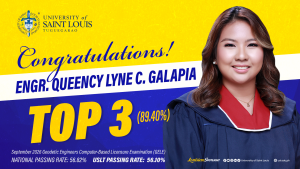
2 Louisian grads land Top 3, Top 7 in September 2026 GELE
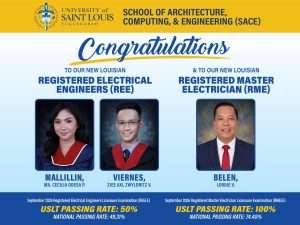
USLT produces 2 REEs; 1 RME

SACE recognizes academic scholars
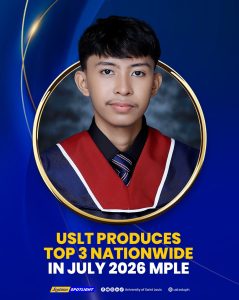
USLT produces Top 3 nationwide in July 2026 MPLE

USLT recognizes board topnotchers, top performing schools in 55th Commencement Exercises

USLT earns 90% passing rate in June 2026 ALE
- MO
- TU
- WE
- TH
- FR
- SA
- SU
- 26
- 27
- 28
- 29
- 30
- 31
- 1
Events for November
1
- 2
- 3
- 4
- 5
- 6
- 7
- 8
Events for November
2
Events for November
3
Events for November
4
Events for November
5
Events for November
6
Events for November
7
Events for November
8
- 9
- 10
- 11
- 12
- 13
- 14
- 15
Events for November
9
Events for November
10
Events for November
11
Events for November
12
Events for November
13
Events for November
14
Events for November
15
- 16
- 17
- 18
- 19
- 20
- 21
- 22
Events for November
16
Events for November
17
Events for November
18
Events for November
19
Events for November
20
Events for November
21
Events for November
22
- 23
- 24
- 25
- 26
- 27
- 28
- 29
Events for November
23
Events for November
24
Events for November
25
Events for November
26
Events for November
27
Events for November
28
Events for November
29
- 30
- 1
- 2
- 3
- 4
- 5
- 6